
The procedure is only part of the challenge
Anticipation, unfamiliar equipment, previous memories and attention fixed on the clinical environment can make a short procedure feel much bigger to a child.
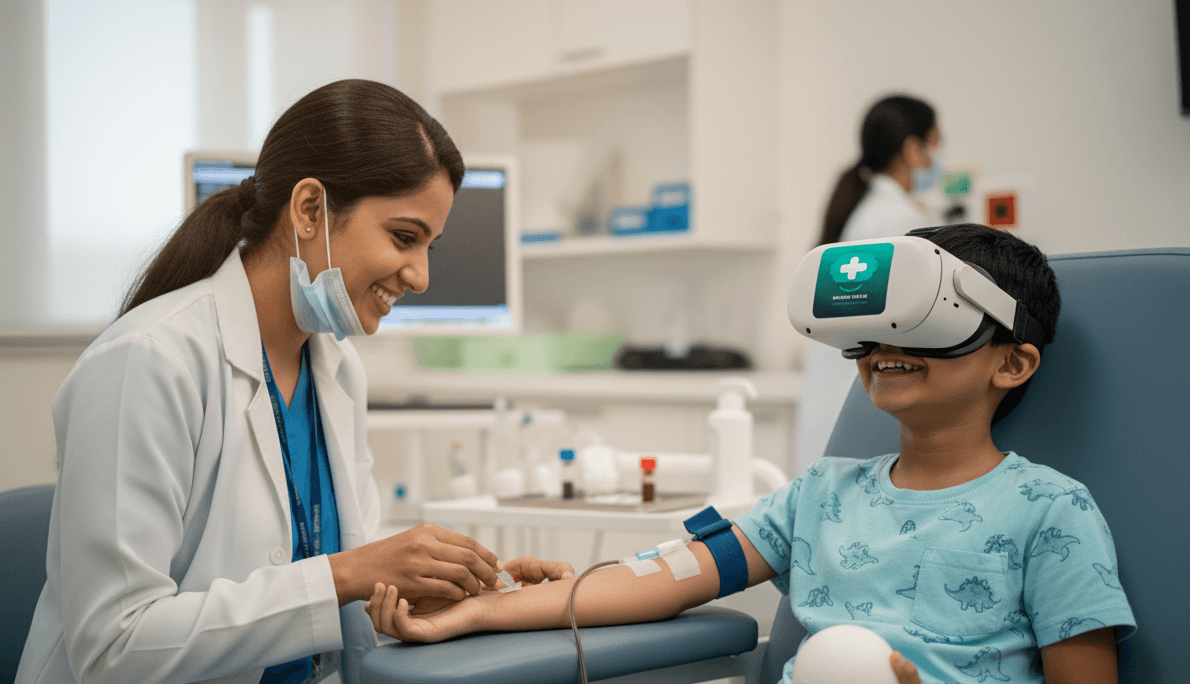
Children wear a VR headset and play in a calm, interactive world while nurses and doctors carry on with normal care. It is designed for the moments children find hardest, like needles and blood tests.
With the studied interactive VR + touch approach, compared with standard VR during blood tests.
Pain score after the procedure · 0 = no pain, 10 = worst · lower is betterStandard VR5.0/10
Our studied approach: interactive VR + touch1.8/10
Two groups in a randomized study of 50 participants during blood tests; individual results vary. Published by Springer Nature in 2026. See the full results →
Springer Nature conference proceedings, 2026
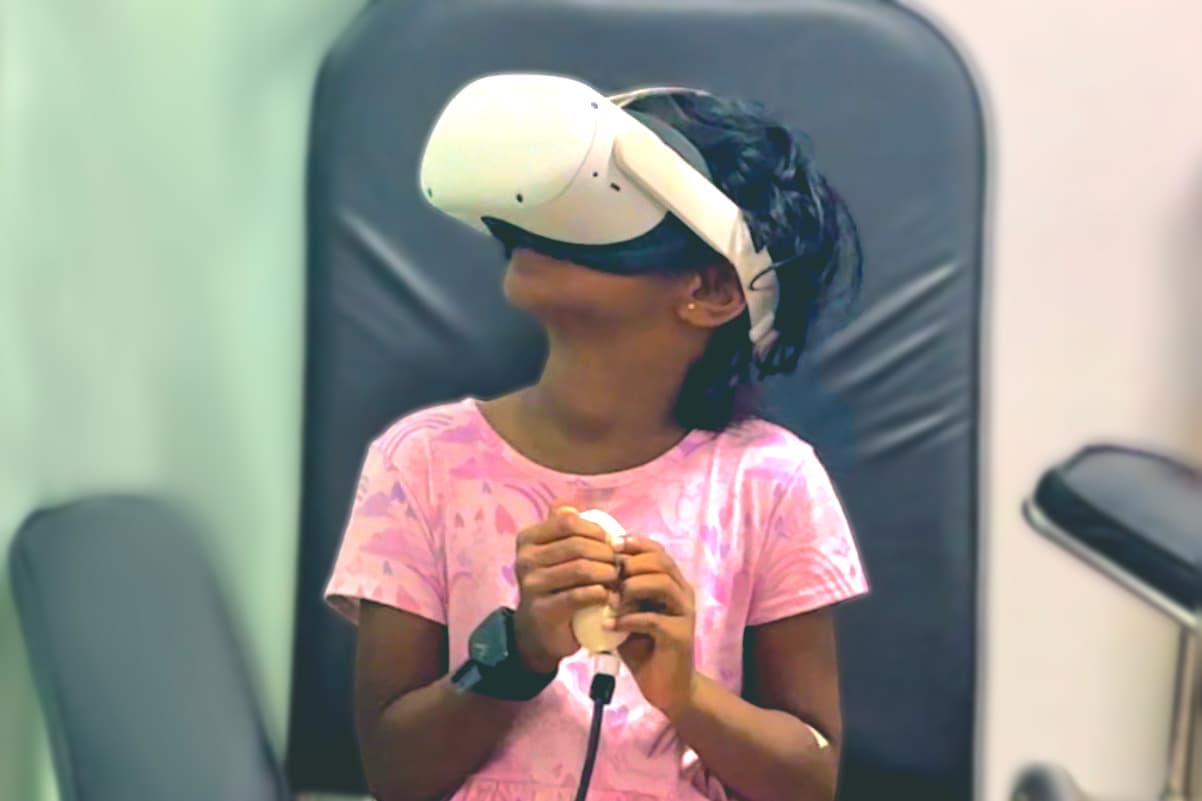
A squeeze ball lets the child interact with the virtual world
Used alongside normal care, never instead of it
Hospitals and research teams in any country are welcome
Immersive Smile focuses on the experience surrounding pediatric procedures: attention, distress, interaction, cooperation and how the child remembers the moment.
Anticipation, unfamiliar equipment, previous memories and attention fixed on the clinical environment can make a short procedure feel much bigger to a child.
Healthcare professionals may need to support the child, reassure the family and maintain cooperation while also completing the procedure safely.
A difficult medical moment can shape how a child approaches future care. Better procedural experiences matter beyond a single visit.
The child enters an engaging virtual environment while the healthcare team continues normal care. Research behind Immersive Smile explored how physical interaction and adaptive environments could go beyond passive VR distraction.
Age-appropriate virtual environments offer an alternative place for attention.
Tactile input can connect a physical action with events inside the virtual world.
Academic prototypes explored contextual signals and reinforcement learning.
The experience supports care. It does not replace medical treatment or judgment.
Short concept films showing how Immersive Smile Plus is meant to feel for a child: one in the setting we have studied, and one in a setting we want to study with hospital partners.
Both films are dramatized. They illustrate the experience and are not clinical recordings or evidence of outcomes.
The published randomized study compared static VR with adaptive VR plus sensor-enabled tactile feedback during venipuncture.
Two different groups of 25, not a before-and-after result. Findings apply to the study population and venipuncture setting and should not be assumed for other procedures.
We are building the next generation of pediatric immersive care with healthcare institutions, not in isolation.
Explore clinical fit, workflow and the questions an appropriate evaluation should answer.
Discuss this pathway →Define a study question, comparator and meaningful outcomes with your research team.
Discuss this pathway →Co-develop a new experience and the evidence its clinical setting requires.
Discuss this pathway →Discuss market readiness, local requirements and training and support responsibilities.
Discuss this pathway →Each step grew from feedback and research.
VR sessions and honest feedback: patients wanted more to do, not just more to watch.
A squeeze input let the child take part and see the virtual world respond.
50 participants during blood tests, published by Springer Nature in 2026.
Next: inviting clinical teams to test it where care happens.
Open, printable and free. No sign-up needed.
Short, honest answers. For the full detail, see the clinical evidence.
A virtual reality (VR) experience for children during medical procedures such as needles and blood tests. The child wears a VR headset, explores an interactive world and uses a simple squeeze ball, while nurses and doctors carry on with normal care.
In a randomized study of 50 participants during blood tests (venipuncture), the group using adaptive VR with touch reported an average pain score of 1.8 out of 10, compared with 5.0 out of 10 for standard VR. This compares two groups, and individual results vary. The study was published by Springer Nature in 2026.
The published study looked at blood tests. Other uses, such as IV cannulation, repeated procedures or recovery after surgery, are research directions that need their own evaluation.
No. It is used alongside normal care, never instead of pain relief, anaesthesia or clinical judgment.
The clinical team decides whether it suits each child, and the child can decline or stop at any time.
Request a hospital pilot through the contact page or email support@immersivesmile.com. The team is based in Colombo, Sri Lanka, and welcomes hospitals and research groups in any country.
Immersive Smile is a team working across research, technology and design, together with academic and clinical collaborators. You can meet the people behind the work on our People page.
Springer Nature · 2026
Jaiyramanan Vijayaalayan · Prasad Wimalaratne
DOI 10.1007/978-3-032-10951-4_6
We welcome conversations with pediatric departments, hospitals, healthcare groups, universities and clinical researchers interested in evaluating and advancing Immersive Smile.